
Volume 1, Issue 26. Friday, June 5, 2026. Sent 7:00 am ET / 14:00 GST.
The risk that should keep a long-horizon owner up at night is no longer any single fault line — it is several of them breaking together. That is the message from the global financial-stability watchdog's June meeting, and this Friday's Risk Radar reads it against the places the strain is already visible: a private-credit market posting record defaults even as pension funds keep adding to it, and the world's largest fund's stewardship engine sitting idle while its rulebook is rewritten. Plus the chart of the day and three links worth your time.
1. The Financial Stability Board's new worry is correlation — and it named two fresh shocks to the list.
Meeting in London on June 1, the Financial Stability Board — the body that coordinates financial regulation across 24 jurisdictions for the G20 — used its plenary statement to shift the framing of systemic risk. The danger it stressed was not a single vulnerability but their coincidence: members "expressed particular concern that a combination of shocks could concurrently trigger multiple vulnerabilities, threatening financial stability." Asset valuations remain high and risk premia compressed; sovereign debt is elevated with shortening maturities and a growing use of leveraged trading strategies in government-bond markets; and private credit "has grown rapidly, and parts of the sector remain untested in a prolonged economic downturn."
To that standing list the FSB added two developments it said had "further complicated the risk landscape." First, the conflict in the Middle East — energy and commodity markets, higher inflation, and rising bond yields. Second, the arrival of powerful frontier AI models, which the board warned "may sharply increase cyber risks." "There is growing concern over new vulnerabilities to global financial stability," said FSB Chair Andrew Bailey, the Bank of England governor.
For a universal owner, the operative word is concurrently. A portfolio stress-tested against one shock at a time can still be fragile to two arriving together — a commodity-price spike that lifts yields while a cyber outage freezes a critical market node. The FSB is telling allocators to test the joints, not just the limbs.
Source: Financial Stability Board, June 1, 2026. | Coverage: The Universal Owner Risk Radar, Friday, this week.
2. The vulnerability the FSB keeps flagging is already showing up in the data.
The private-credit warning is not abstract. In its dedicated report of May 6, 2026, the FSB sized the global private-credit market at roughly $1.5–2.0 trillion in assets at end-2024, "heavily concentrated in a few jurisdictions," and warned that its "complexity, leverage, and interconnectedness could amplify stress in adverse scenarios." The report singled out valuation opacity, reliance on private credit ratings — increasingly from "lesser-known providers" — and the procyclical risk in funds that offer investors redemption options against illiquid assets.
The stress markers have begun to print. In a report released May 18, 2026, Fitch Ratings put the US private-credit default rate at a record 6.0% for the 12 months to end-April — 99 default events, 81 of them first-time defaulters — and earlier in the year several semi-liquid private-credit funds received redemption requests exceeding their stated withdrawal limits, prompting managers to restrict withdrawals. The asset class the regulator describes as "untested in a prolonged downturn" is getting an early, partial test — and the gates are the tell.
Source: Financial Stability Board, May 6, 2026.
3. Pension funds are still adding to the asset class the regulators just flagged.
Here is the governance tension on the trustee's desk. Even as the FSB and the IMF warn on private credit, retirement institutions keep raising allocations — drawn by yields the public markets no longer offer. As reported on May 8, 2026, pension funds are "doubling down" on private credit "despite deepening cracks," and on May 20 one of Switzerland's largest pension funds was reported to be weighing up to $1.1 billion in direct lending. The IMF has separately warned that insurers and pension funds using leverage against private credit "could face larger-than-expected losses during periods of stress."
The read-across is not that private credit is uninvestable — it is that the due-diligence burden has moved. A board adding to an asset class its own regulator calls opaque, leveraged, and untested owns the obligation to look through to valuation methodology, redemption terms, and the rating provider behind the number. The yield is visible; the risk, by the regulators' own account, is not.
4. The world's largest fund's stewardship engine is paused.
While the systemic dials flash, the single most-watched stewardship machine in the world is in a holding pattern. Norway's parliament has suspended new exclusion and observation decisions for its roughly $2-trillion Government Pension Fund Global while a committee chaired by former central-bank governor Svein Gjedrem reviews the ethical framework underpinning the fund's responsible-investment guidelines, with a report due October 15, 2026. Under the temporary guidelines, Norges Bank cannot add new companies to its exclusion or observation lists — though it may revoke prior exclusions; reporting has tied the pause to the prospect of excluding large technology holdings.
The fund's voting and engagement continue, but its sharpest tool — the threat of divestment that moves boards because the buyer of last resort is the world's largest single equity owner — is sheathed pending the review. For the universal-owner community that takes its cues from Oslo, the question is whether a months-long pause leaves a stewardship vacuum at precisely the moment the FSB is warning that governance and resilience matter most.
Source: Chief Investment Officer, 2026.
— Chart of the day —
The financial-stability watchdog's June risk board — the vulnerabilities it now ranks elevated, and the two it just added.
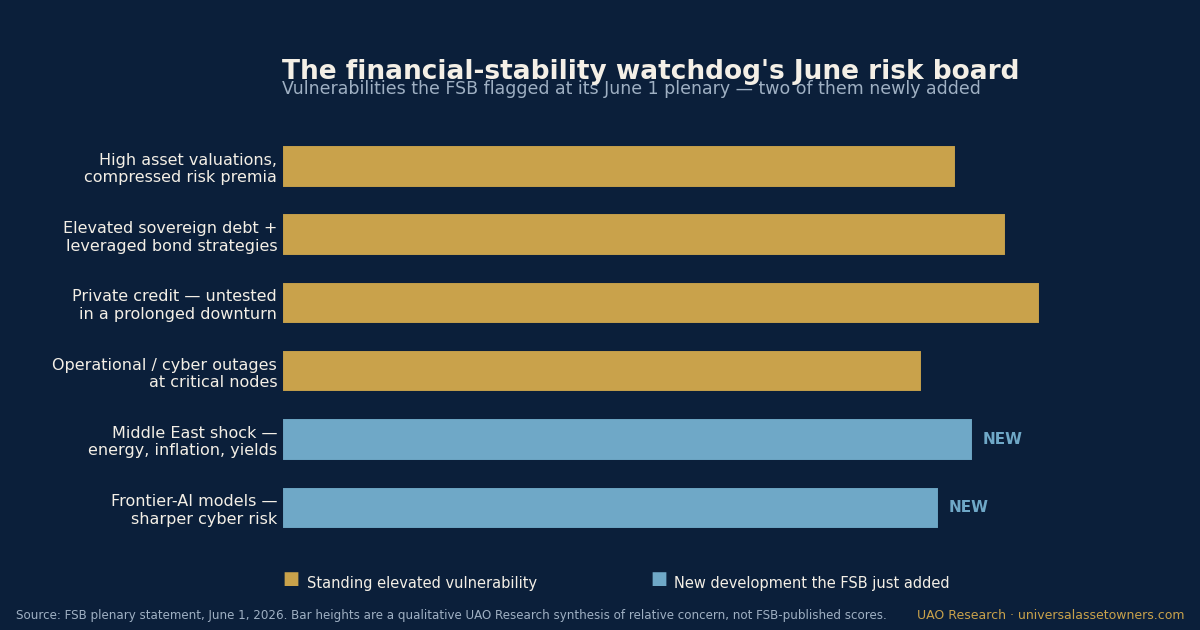
Source: FSB plenary statement, June 1, 2026. UAO Research synthesis, 2026.
— Take of the day —
"The FSB's shift from listing vulnerabilities to warning about their coincidence is the whole story. A universal owner's real exposure is not private credit, or sovereign-debt leverage, or a cyber outage — it is the correlation between them that no single risk model prices well. The discipline this demands is unglamorous: stop asking what each risk does alone, and start asking which two arrive together."
— UAO Research.
— Three links worth your time —
- Financial Stability Board — Report on Vulnerabilities in Private Credit (PDF). The primary document behind the warning — read the sections on valuation opacity and redemption procyclicality before your next private-credit commitment.
- International Monetary Fund — Global Financial Stability Report, April 2026, Chapter 1. The IMF's parallel mapping of private-credit leverage and the insurer-pension channel — the academic spine under the FSB's headline.
- CNBC — Why pension funds are doubling down on private credit despite deepening cracks. The clearest narrative read on why retirement boards keep buying the risk the regulators keep flagging.
The UAO Daily Brief is produced by Universal Asset Owners — intelligence for long-horizon capital. Read the archive and The Universal Owner Risk Radar franchise at universalassetowners.com. Questions, corrections, or to reach the desk: info@universalassetowners.com. Not investment advice.
Continue the briefing. Read the daily brief · watch the daily video briefing · listen to The Allocator Briefing · view the chart of the day.
Produced and edited by the UAO editorial desk. Not investment advice.