
Volume 1, Issue 25. Thursday, June 4, 2026. Sent 7:00 am ET / 14:00 GST.
The wartime test most allocators expected the Gulf to fail, it passed: through the Iran conflict, the region's sovereign funds kept deploying, and most of the money went to developed markets. Today's brief reads the June capital-flow map — where Gulf state capital actually went, the split opening up inside the Gulf itself, the official reserve managers quietly stepping the other way on the dollar, and why healthy-looking emerging-market inflows are not what they seem. Plus the chart of the day and three links worth your time.
1. The Gulf didn't flinch — sovereign funds kept deploying through the war, mostly into developed markets.
The Iran war that began on February 28 was supposed to slow the Gulf's biggest investors down. It did not. In its June report, the tracker Global SWF found that the state funds of the six-member Gulf Co-operation Council — managing about $5.7 trillion between them — held their quarterly investment pace, with most of the capital flowing into developed-market assets, chiefly the United States. "These vehicles have shown no sign of slowdown yet, with a stronger average pace in the past quarter than in the five years before the start of the war," Global SWF said.
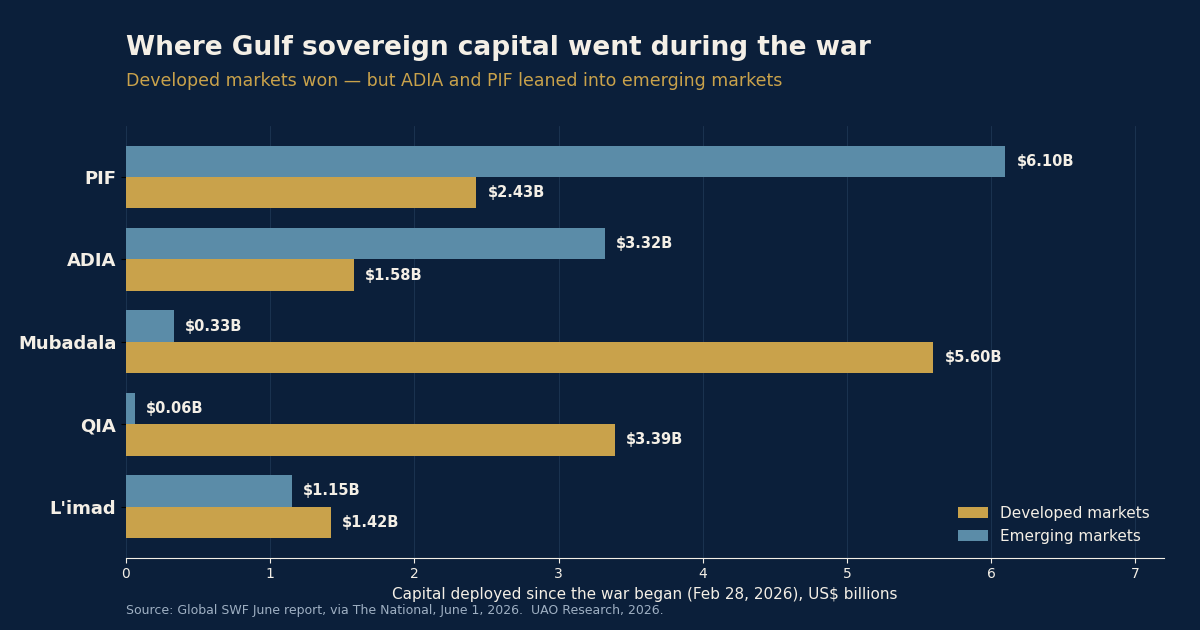
The per-fund numbers, dated to the months since the war began, are striking. Abu Dhabi's Mubadala put more than $5.6 billion into developed markets against just $330 million in emerging markets; Qatar's QIA, $3.39 billion developed versus $60 million emerging; Abu Dhabi's newly created L'imad platform, $1.42 billion developed versus $1.15 billion emerging. Only QIA trimmed its overall pace, running about $2 billion lighter per quarter since March 1.
For a universal owner, the read-across is about behavior under stress. The largest discretionary pools of state capital in the world treated a regional war not as a reason to retreat to cash but as cover to keep adding long-duration exposure abroad — and they voted, with real money, for developed markets.
Source: The National, June 1, 2026. | Coverage: Capital Flow Watch, Thursday, this week.
2. Inside the Gulf, the money is splitting — only ADIA and PIF are leaning into emerging markets.
The same Global SWF data shows the Gulf is not moving as a bloc. The two largest funds broke from the developed-market herd: Saudi Arabia's Public Investment Fund, with assets approaching $1 trillion, put $6.1 billion into emerging markets against $2.43 billion in developed markets since the war began; Abu Dhabi's ADIA, estimated by Global SWF at roughly $1.1 trillion, deployed $3.32 billion to emerging markets versus $1.58 billion developed. "The capital has continued to flow into US companies and funds, with only ADIA and PIF showing a preference for China and other emerging markets," the report said.
That divergence matters because it is the two biggest, most sophisticated balance sheets in the region taking the contrarian side. When the largest sovereign investors tilt toward emerging markets while their peers crowd into US assets, allocators should at least ask which group is early and which is comfortable.
Source: The National, June 1, 2026.
3. The counter-current: official reserve managers are easing off the dollar even as private money pours into US assets.
Set the Gulf's developed-market buying against what the official sector is doing and a split appears. In research published in May 2026, OMFIF found the dollar had fallen sharply in central banks' demand rankings, with roughly 70% of reserve managers citing the US political environment as a deterrent and gold ranking as the most-demanded reserve asset. The hard data points the same way: US Treasury International Capital figures for March 2026 showed foreign official institutions net-sold about $14.9 billion of long-term Treasuries even as private foreign investors bought $111.4 billion (both figures dated to the March release).
The picture is a public-versus-private divergence in who finances the United States. Rules-based reserve managers are diversifying away from the dollar for reasons of sanctions risk and resilience; discretionary private and sovereign capital keeps adding US exposure for return. A universal owner sits on both sides of that line at once.
Source: OMFIF, May 2026. · U.S. Treasury TIC, March 2026.
4. Emerging-market inflows look healthy — but the gains are official money, not private conviction.
The headline number flatters the trend. The Institute of International Finance projects non-resident flows to emerging markets rising to about $935 billion in 2026, up from roughly $887 billion in 2025. But it expects private non-resident flows to fall, with the projected increase driven almost entirely by official flows to Argentina and Ukraine. Strip out the policy-driven money and the broad private appetite for emerging-market risk is thinner than the aggregate suggests.
That is the through-line of today's brief: capital that persists is increasingly selective. Whether it is the Gulf concentrating in US assets, reserve managers leaving the dollar, or official lenders carrying emerging-market inflows, the flows are being made deliberately, fund by fund and policy by policy — not as a single tide.
Source: Institute of International Finance, 2026.
— Chart of the day —
Where Gulf sovereign capital went during the war — developed markets won, but ADIA and PIF leaned the other way.
Source: Global SWF June report, via The National, June 1, 2026. UAO Research, 2026.
— Take of the day —
"The Gulf's wartime buying and the official sector's dollar diversification are not contradictory — they are the same signal seen from two seats. Discretionary capital is paid to take the US exposure that rules-based reserve managers are now paid to reduce. The universal owner's job is not to pick a side but to recognize that 'safe haven' has quietly become a relative, position-dependent idea rather than a fixed address."
— UAO Research.
— Three links worth your time —
- Fortune — The opposite is true: the Iran conflict didn't curb the Gulf's appetite for global investments. The clearest narrative read on why wartime uncertainty failed to slow Gulf deployment.
- IMF — Capital Flows to Emerging Markets: Disentangling Quantities from Prices (WP 2026/060). The analytical case that emerging-market flows are now driven by idiosyncratic, not common, shocks — selectivity as structure.
- Reason — Bernie Sanders' AI sovereign-wealth-fund proposal, dissected. A skeptical look at the June 2 bill to seed a US sovereign fund with AI-company equity — sovereign-capital ideas are going mainstream in Washington.
The UAO Daily Brief is produced by Universal Asset Owners — intelligence for long-horizon capital. Read the archive and the Capital Flow Watch franchise at universalassetowners.com. Questions, corrections, or to reach the desk: info@universalassetowners.com. Not investment advice.
Continue the briefing. Read the daily brief · watch the daily video briefing · listen to The Allocator Briefing · view the chart of the day.
Produced and edited by the UAO editorial desk. Not investment advice.