
Volume 1, Issue 23. Tuesday, June 2, 2026. Sent 7:00 am ET / 14:00 GST.
The most concentrated pool of long-horizon capital on earth just deployed almost $26 billion in three months — and it did so into its own region's war. Today: the Global SWF quarter-end tally on Gulf dealmaking through the Iran conflict; the quiet emerging-markets tilt at the two largest funds; PIF spending and pruning at the same time; and the energy backdrop, with Brent back above $95 and the Strait of Hormuz still effectively shut. The through-line for a universal owner is uncomfortable: the funds recycling the world's largest petrodollar surplus are accelerating, not slowing, as the shock that funds them turns against them.
1. Gulf sovereign funds spent almost $26 billion through the war — faster than their five-year pace, with the Strait of Hormuz shut.
The five biggest Gulf state investors — Abu Dhabi's ADIA, L'IMAD and Mubadala, Saudi Arabia's Public Investment Fund, and the Qatar Investment Authority — collectively deployed close to $26 billion across March, April and May 2026, a higher run-rate than their average over the previous five years, according to Global SWF data reported Monday. The six-member Gulf Cooperation Council's state funds manage roughly $5.7 trillion between them.
What makes the number remarkable is the backdrop. The Iran war began February 28, and Iran's closure of the Strait of Hormuz — the chokepoint for about a fifth of seaborne oil — has hit the same oil revenue that ultimately fills these funds. The intuitive expectation was retrenchment: hoard cash, defend the currency peg, wait out the shock. The funds did the opposite. Deal-making, cross-border flows and long-term commitments ran above trend.
For a universal owner, this is the signal worth sitting with. These funds are not trading the news; they are pressing a multi-decade view through a live conflict — and in doing so they are setting the clearing price for large private assets that every other allocator competes for. When the buyer of last resort is also the fastest buyer during a war, the rest of the market is taking the other side of that conviction.
Source: Semafor (Matthew Martin), citing Global SWF, June 1, 2026. | Coverage: Sovereign Wealth Monitor, this week.
2. The two biggest Gulf funds tilted toward emerging markets — while the rest crowded into developed-market deals.
Underneath the headline pace sits a split. The two largest Gulf investors, PIF and ADIA, put more capital into emerging than developed markets over the period — PIF roughly $6.1 billion into emerging markets against about $2.43 billion in developed assets, anchored by a near-$6 billion stake in Chinese game developer Moonton Technology; ADIA about $3.32 billion emerging against $1.58 billion developed. The rest leaned the other way: Mubadala put roughly $5.6 billion into developed markets versus about $330 million emerging, and QIA around $3.39 billion developed against just $60 million emerging.
The divergence matters because it is not random. The two funds with the deepest pockets and the longest horizons are the ones leaning into China and other emerging markets at the moment Western allocators are most cautious about them. That is either a contrarian edge built on patient capital, or a tolerance for political risk that a fiduciary pension could never carry — and the gap between those two readings is exactly what a CIO co-investing alongside Gulf capital has to price.
Source: IndexBox, citing Global SWF, June 1, 2026.
3. PIF is the most active Gulf fund — and it is pruning while it spends.
Saudi Arabia's PIF was the single most active Gulf investor in the quarter, yet it pulled back on some of its more conspicuous bets at the same time — including a decision to stop funding LIV Golf, throwing the breakaway tour's future into question. The Qatar Investment Authority was the only one of the five to slow its overall pace.
The detail is more telling than the golf headline. A fund deploying above-trend while cutting trophy projects is behaving less like a strategic-influence vehicle and more like a returns-disciplined allocator — the "more disciplined approach to allocations" PIF has signalled in its 2026–2030 strategy. For owners who track Gulf capital as both a competitor for assets and a potential co-investor, a PIF that prunes is a different counterparty than a PIF that spends for prestige.
Source: Semafor, June 1, 2026.
4. The energy backdrop: Brent is back above $95 with the Strait of Hormuz effectively shut.
Brent crude rose about 5% to trade above $95 a barrel on the first trading day of June as the Strait of Hormuz stayed effectively closed; the war began February 28. The spike is double-edged for Gulf owners: higher prices swell the surplus that ultimately feeds the funds, but a blocked Strait throttles the volumes — and the tourism, trade and hospitality revenue — that the price is supposed to monetise.
That is the real tension behind the $26 billion. The funds are deploying into the world because their home base is concentrated in a single, now-contested, commodity and a single chokepoint. Diversifying out of correlated risk is the founding logic of a sovereign wealth fund; doing it faster during the shock it was built to hedge is the logic working in real time — or the moment it is tested hardest.
Source: Trading Economics (Brent crude), accessed June 2, 2026.
— Chart of the day —
Where Gulf sovereign capital went during the war: emerging vs developed markets, by fund (March–May 2026).
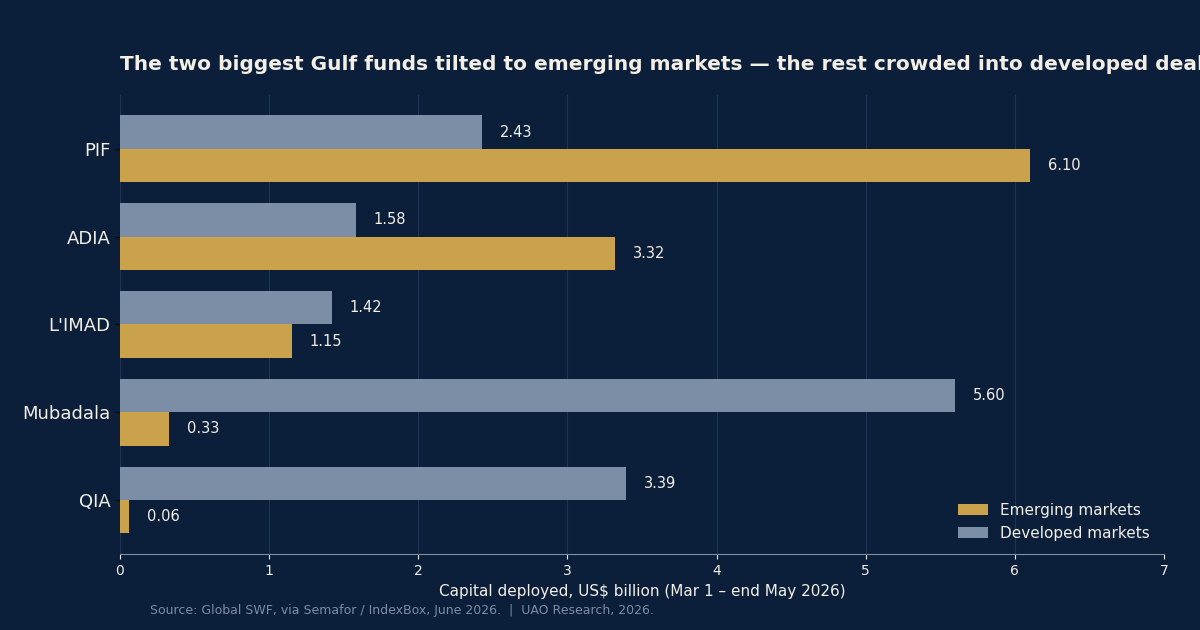
Source: Global SWF, via Semafor / IndexBox, June 2026. UAO Research, 2026.
— Take of the day —
"Deploying $26 billion faster than trend, into the teeth of a war that is choking your own oil revenue, is not recklessness — it is the sovereign-fund thesis taken to its logical end: the only hedge against owning one correlated risk is to own everything else, and to do it before the price moves. The question the rest of the market should ask is not whether the Gulf funds are brave, but why they are the only buyers willing to be."
— UAO Research.
— Three links worth your time —
- Semafor — Gulf funds step up dealmaking despite Iran war. The Monday tally that frames the whole day — numbers and the LIV Golf pullback in one place.
- Arab Center Washington DC — Protection or Vulnerability? Gulf Sovereign Wealth Funds and the Iran War. The sharpest framing of whether deploying through the war reduces or concentrates the funds' exposure.
- OECD — Are Sovereign Wealth Funds' Investments Politically Biased? The primary-research baseline for the political-vs-returns debate this week's numbers reignite.
Continue the briefing. Read the daily brief · watch the daily video briefing · listen to The Allocator Briefing · view the chart of the day.
Produced and edited by the UAO editorial desk. Not investment advice.