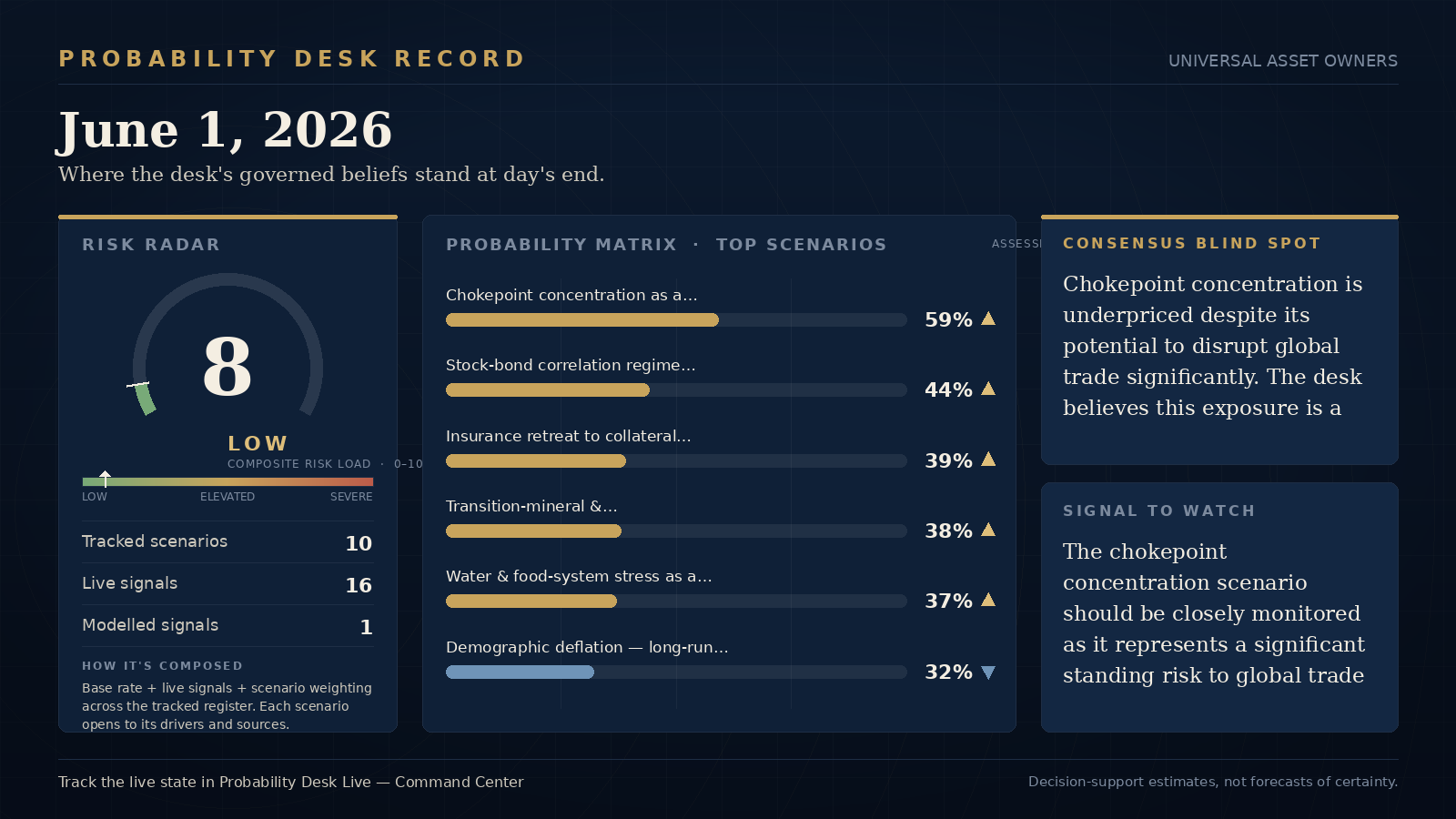
Where the desk’s governed beliefs stand at day’s end: what moved, what did not, the consensus blind spot, and what to watch next.
1 · Today’s Probability State
Today's probability state is governed by a Risk Radar score of 8, labeled as Low, with 10 scenarios tracked and 16 live signals. There was 1 modelled scenario and 11 feeds unavailable. The highest-priority scenario is 'Chokepoint concentration as a standing factor (Hormuz + Taiwan + Malacca + Panama).' The most important probability movement is the increase in chokepoint concentration probability.
How to read this Record
Risk Radar is a composite of base rates, live signals, and scenario weighting across the tracked register — it is the overall load, not any single scenario. Each probability below is that scenario’s assessed likelihood (0–100%); ↑/↓ is the change versus the prior record. Every scenario opens to its drivers and sources.
2 · What Moved
Moved higher
Moved lower
3 · What Did Not Move
The stability in scenarios such as 'Insurance retreat to collateral repricing' and 'Transition-mineral & grid-interconnection bottleneck' is informative. It suggests that while these risks remain significant, there is no immediate catalyst driving their probabilities higher. This stability could imply that current market and policy responses are effectively managing these risks, or that they are not yet fully appreciated by the market.
4 · Consensus Blind Spot
Chokepoint concentration is underpriced despite its potential to disrupt global trade significantly. The desk believes this exposure is a standing risk, not episodic, due to geopolitical tensions.
5 · Simulation View
An agent-based scenario simulation runs alongside the governed ensemble as a dedicated leg. It currently carries 0 percentage points of weight on every published probability above, capped at 5pp, and remains calibration-gated — calibration day 4 — so it does not move the numbers. Its role for now is to surface the structural blind spots the desk then investigates.
This session the simulation centred on Chokepoint concentration as a standing factor (Hormuz + Taiwan + Malacca + Panama) and flagged:
- Insurance/freight cost-push as a distinct inflation channelDesk follow-up: size historical insurance/freight cost-push vs oil in past chokepoint episodes; add to inflation stress test
- Friend-shoring eroding the globalization dividend in CMAsDesk follow-up: quantify globalization-dividend assumption in our return model; sensitivity to friend-shoring
- Reflexive actors who trade the volatility and amplify itDesk follow-up: measure order-book reflexivity in prior strait incidents; second-order feedback in scenario model
6 · Signal to Watch
The chokepoint concentration scenario should be closely monitored as it represents a significant standing risk to global trade routes.
7 · Question for Tomorrow
How should long-duration capital allocators adjust for potential disruptions in global trade routes?
8 · Command Center
Track the live state in Probability Desk Live — Command Center.
9 · Methodology & Source Note
Review the desk’s methodology and source ledger, or read the deeper scenario reports.
Editorial scenario analysis only. Not investment, actuarial, legal, geopolitical, or financial advice.