Where the desk’s governed beliefs stand at day’s end: what moved, what did not, the consensus blind spot, and what to watch next.
1 · Today’s Probability State
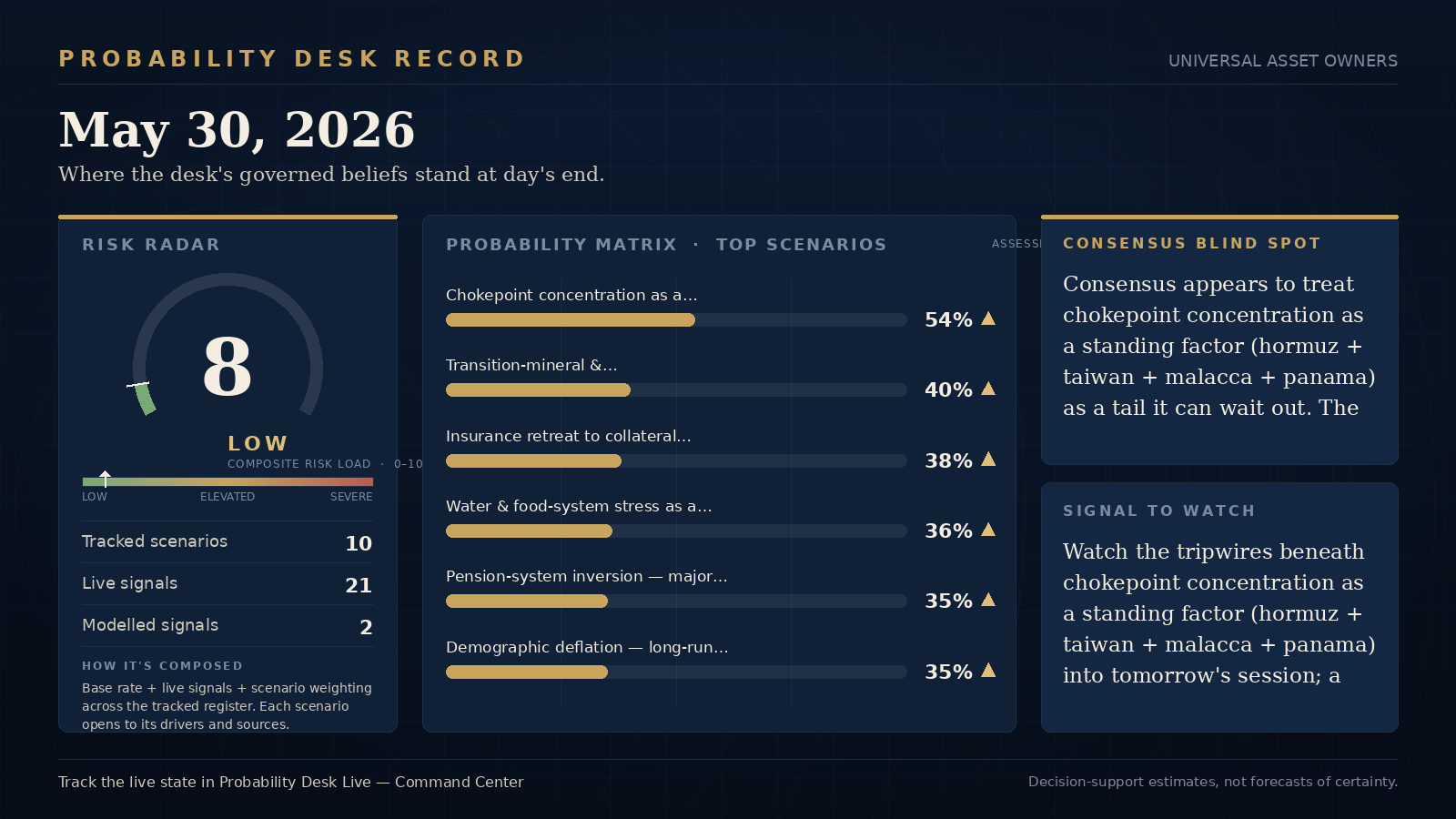
The Risk Radar reads 8 (Low). The desk tracks 10 scenarios on 21 live signals. The highest-priority scenario is Chokepoint concentration as a standing factor (Hormuz + Taiwan + Malacca + Panama). The largest move was Chokepoint concentration as a standing factor (Hormuz + Taiwan + Malacca + Panama), now 54% (+14pp).
How to read this Record
Risk Radar is a composite of base rates, live signals, and scenario weighting across the tracked register — it is the overall load, not any single scenario. Each probability below is that scenario’s assessed likelihood (0–100%); ↑/↓ is the change versus the prior record. Every scenario opens to its drivers and sources.
2 · What Moved
Moved higher
Moved lower
3 · What Did Not Move
The risks that held steady are as informative as those that moved: stability at elevated levels means the desk is not de-rating structural exposures simply because they did not make headlines today.
4 · Consensus Blind Spot
Consensus appears to treat chokepoint concentration as a standing factor (hormuz + taiwan + malacca + panama) as a tail it can wait out. The desk's reference class suggests structural repricings of this kind unfold slowly and then all at once, which is precisely when long-duration capital has least room to adjust.
5 · Signal to Watch
Watch the tripwires beneath chokepoint concentration as a standing factor (hormuz + taiwan + malacca + panama) into tomorrow's session; a confirmed move there would carry more weight than any single print.
6 · Question for Tomorrow
If this scenario is mispriced, where in the portfolio would we feel it first, and is that exposure intentional?
7 · Command Center
Track the live state in Probability Desk Live — Command Center.
8 · Methodology & Source Note
Review the desk’s methodology and source ledger, or read the deeper scenario reports.
Editorial scenario analysis only. Not investment, actuarial, legal, geopolitical, or financial advice.