UAO Research · May 15, 2026 · Stewardship, Governance & Risk · Feeds: The Universal Owner Risk Radar
A universal owner cannot diversify away from private credit. At $1.5–2 trillion and embedded in pension, insurance and sovereign portfolios, it is now a systemic position, not a satellite one. So the question raised by the Financial Stability Board's May 6 report is not "should we be in private credit" — most large owners already are, structurally — but "what do we need to know, and document, before this asset class meets its first severe downturn." This is a Risk Radar question, and the evidence to answer it is unusually good right now.
What the evidence says
Four credible bodies have converged on the same shortlist of vulnerabilities, which is itself a signal worth weighting.
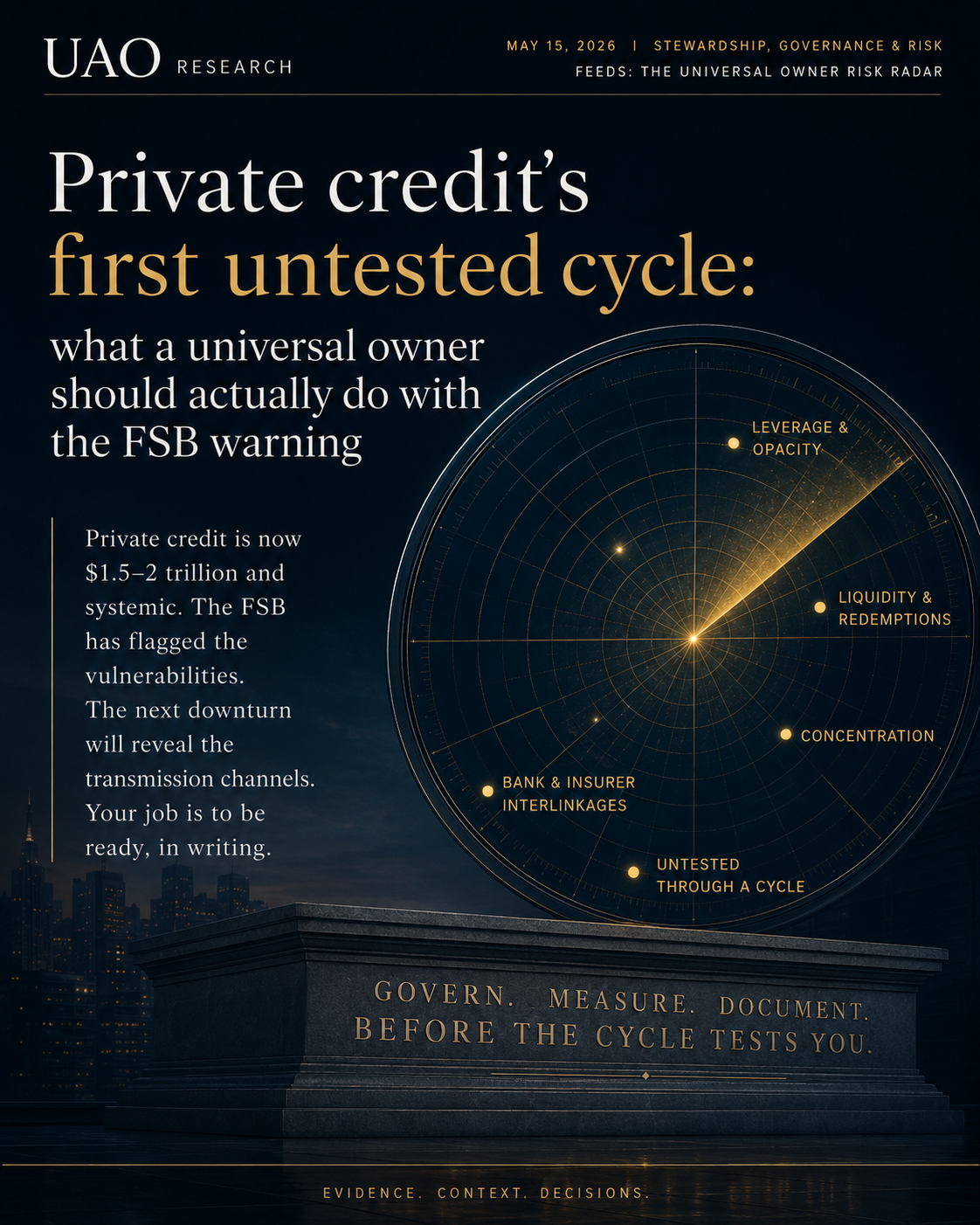
The FSB's Report on Vulnerabilities in Private Credit identifies leverage in opaque, multi-layered structures; liquidity risk from the rise of semi-liquid funds offering investor redemptions; concentration in technology, healthcare and services; and bank-and-insurer interlinkages the data cannot yet size — members captured roughly $220 billion of bank credit lines to private credit funds, while the regulator warns the real figure could be more than double that (FSB, May 6, 2026). The IMF reached a strikingly similar conclusion in its Global Financial Stability Report chapter on the asset class, naming five vulnerabilities: fragile borrowers, semi-liquid vehicles, multiple layers of leverage, stale and subjective valuations, and unclear interconnections (IMF, The Rise and Risks of Private Credit). The U.S. Office of Financial Research, in a March brief, put numbers on the interconnection point specifically — finding that global systemically important banks and other banks are the predominant funding source for private credit funds (OFR Brief 26-02, March 12, 2026). And a March 2026 academic review of the private credit literature frames the borrower-quality concern precisely: private credit borrowers are smaller, more leveraged and more sensitive to rate increases than broadly syndicated loan borrowers (Zou, Private Credit Markets: Theory, Evidence, and Emerging Frontiers, arXiv, March 2026).
The common thread is not that private credit is bad. It is that the asset class has scaled to systemic size without a full-cycle stress test, and that the data needed to see the transmission channels does not yet exist at fund or loan level.
Where it is contested
The disagreement is real and should not be smoothed over. A second strand of analysis — including from regulators reviewing the question — argues that private credit's structure is stabilising: long-locked capital, no depositor runs, losses absorbed by sophisticated institutional investors rather than the banking system. The academic review is explicit that adjudicating this requires disentangling competing effects rather than declaring a verdict. So a universal owner is choosing between two genuinely held positions: private credit as a fragile, untested concentration, or private credit as a shock absorber that moved credit risk off bank balance sheets to investors who can hold it. The honest reading is that the answer is empirical, depends on the next downturn, and cannot be known in advance — which is itself the planning assumption.
From the allocator's seat
The commercial implication is not "reduce the allocation." For most large owners the allocation funds a return target they cannot otherwise hit, and it is illiquid by design. The implication is that the work shifts from sizing the position to governing it. Concretely, an investment team should be able to answer, in writing, before the next committee meeting: what share of the private credit book sits in semi-liquid, redemption-offering vehicles, and what the redemption mechanics are under stress; how much leverage sits between the fund and the underlying loan, including fund-level facilities; what the covenant quality actually is, deal by deal, not at the strategy level; and which banks are on the other side of the fund's credit lines. Americans for Financial Reform has published a usable list of the questions pension trustees should be putting to managers now (AFR, Private Credit Questions Pension Trustees Should Be Asking). The same discipline travels to the AI-infrastructure book, where similar underwriting is being done under a different label. The owners rotating within private credit toward middle-market lending and stronger covenants are already acting on this; the laggard is the owner who can describe the allocation but not the structure underneath it.
What to watch next
The FSB has proposed a core set of comparable metrics — market size, bank and insurer links, leverage, liquidity features, concentration, cross-border activity, borrower credit quality — for authorities to track; watch for the first jurisdiction to adopt them, because that is when the data gap starts to close. Watch the next IMF GFSR for an updated read on valuations and interconnections. Watch the spread of semi-liquid vehicle launches, the FSB's clearest procyclicality concern. And watch the first credit event large enough to test a redemption gate — that is the moment the two contested positions stop being theoretical.
Sources
- Financial Stability Board, Report on Vulnerabilities in Private Credit, May 6, 2026.
- IMF, The Rise and Risks of Private Credit (Global Financial Stability Report chapter).
- U.S. Office of Financial Research, Brief 26-02, Measuring Counterparty Exposures to Private Credit, March 12, 2026.
- Zou, Private Credit Markets: Theory, Evidence, and Emerging Frontiers, arXiv, March 2026.
- Americans for Financial Reform, Private Credit Questions Pension Trustees Should Be Asking Now.
- Dakota, Quarterly Public Pension Allocations Report, Q1 2026.
UAO Research. AI-assisted monitoring and drafting; reviewed and edited by the UAO editorial desk before publication. Not investment advice.